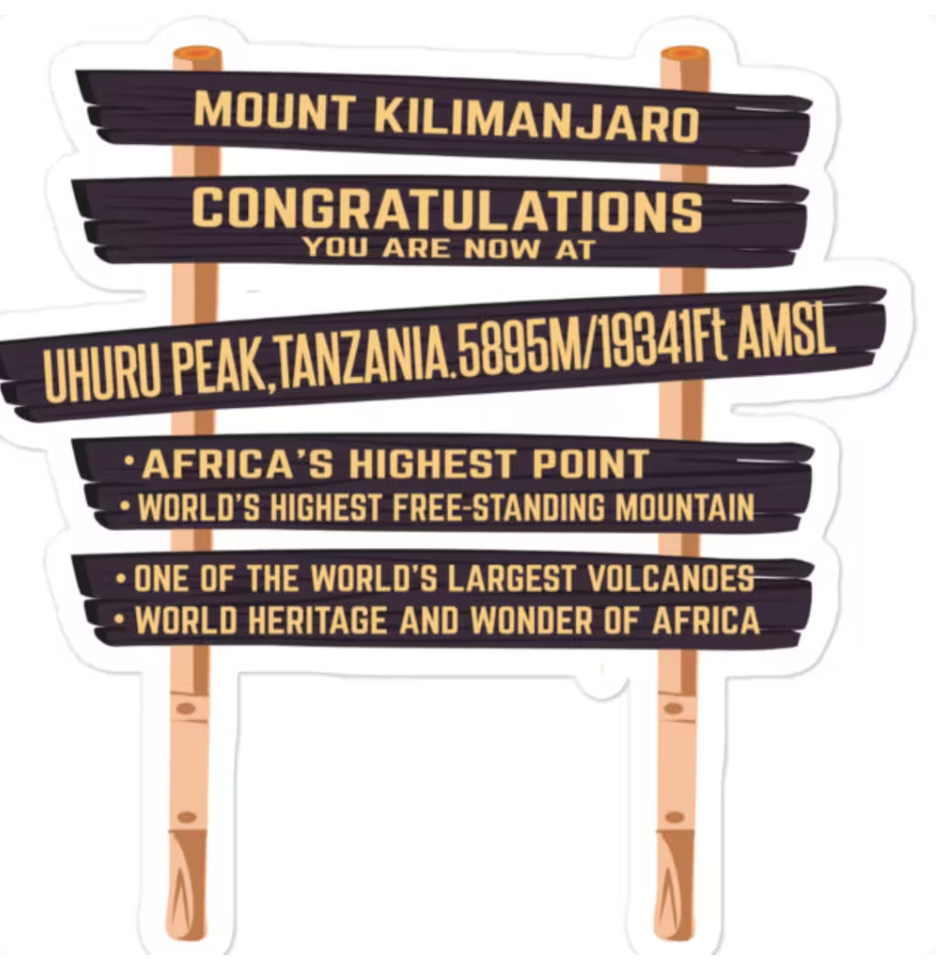
 I Climbed Kilimanjaro
The short version
- Book seven or eight days, not five. This is the single biggest safety and success decision you will make, and it matters more than fitness, gear or brand.
- Altitude is what hurts people, not the terrain. Kilimanjaro requires no climbing skill. It puts an ordinary person at 5,895 m faster than almost any other mountain on earth.
- Learn three warning signs — breathlessness at rest, confusion, loss of coordination — and treat any of them as an emergency requiring descent.
- Check your operator against the KPAP list before you look at anything else on their website.
- Ask about oxygen specifics. "We carry oxygen" means nothing without cylinder size and regulator type.
- Turning back is a normal outcome, not a failure. Roughly a third of people who attempt Kilimanjaro don't reach Uhuru Peak.
- Your guide's judgement is a safety feature you are paying for. So is your own.
How dangerous is Kilimanjaro, really?
Kilimanjaro has a low but real fatality rate, and altitude illness causes most of the deaths. Tanzanian authority records point to an average of 3 to 10 deaths per year among the 30,000 to 50,000 people who attempt the climb, which several operators translate to a mortality rate of roughly 13.6 per 100,000 climbers.
The most-cited underlying research is an autopsy study of climber deaths. It found 25 deaths over the eight years from 1996 to 2003; 14 were attributed to high-altitude illness, with others including pneumonia, falls and appendicitis.
For comparison, that puts Kilimanjaro among the safer mountains of its height — but "safer than Everest" is a low bar, and the deaths that do occur are overwhelmingly preventable.
What actually goes wrong: altitude illness
Around half of Kilimanjaro climbers experience some degree of acute mountain sickness. Most of it is mild and passes. A small proportion progresses to something that can kill within hours. Knowing the difference is the most useful thing on this page.
Acute mountain sickness (AMS) — common, usually manageable
A headache, plus at least one of: nausea, loss of appetite, fatigue, dizziness, or difficulty sleeping. It typically appears 6–12 hours after arriving at a new altitude.
What to do: tell your guide immediately — not at dinner, not tomorrow. Stop ascending until symptoms resolve. Mild AMS that improves with rest is not a reason to abandon the climb. AMS that worsens while resting is.
HAPE — fluid in the lungs
Signs: breathlessness at rest, a persistent cough, extreme fatigue, and a tight or congested chest. It can develop overnight.
This is a medical emergency. Descend immediately.
HACE — swelling of the brain
Signs: confusion, irrational or out-of-character behaviour, severe headache unrelieved by painkillers, and loss of coordination — a person who can't walk a straight line heel-to-toe.
The person affected is often the last to notice. This is why climbing partners matter: you are watching each other, not just yourselves.
The one rule that covers all of it
Descent is the treatment. Oxygen, medication and pressure bags buy time to get someone down; they are not fixes. If you are unsure whether something is serious, go down. Nobody has ever regretted descending too early.
About Diamox and supplemental oxygen
Acetazolamide (Diamox) is widely used to assist acclimatisation and is a genuine, evidence-supported tool — but it is a prescription medicine with side effects and interactions, and the decision belongs with a travel medicine doctor who knows your history. Book that appointment six to eight weeks out, alongside your vaccination and malaria discussion.
Be cautious about routine oxygen use to push through symptoms. It can mask the signals your body is sending and delay the descent that would actually help. Oxygen on Kilimanjaro is emergency equipment, not a performance aid.
How many days should I book?
Seven or eight days is the right answer for almost every first-timer. More nights on the mountain means more acclimatisation, which simultaneously raises your chance of summiting and lowers your chance of getting seriously ill. It is the rare decision where safety and success point the same way.
| Itinerary | Suitable for a first-timer? | Why |
|---|---|---|
| 5 days | No | Insufficient acclimatisation time. Cheapest option and the highest-risk one. |
| 6 days | Marginal | Workable on Marangu or for experienced altitude trekkers. A compressed summit push on Machame is a hard first climb. |
| 7 days | Yes | The sensible minimum. Meaningfully better acclimatisation profile. |
| 8+ days | Best | Highest success rates, lowest risk, more time to notice a problem early. |
If your budget forces a choice between a shorter trip with a good operator and a longer trip with a cheap one, that is a false economy in both directions — the honest answer is to wait and save.
Which route should I choose?
The routes differ mainly in length, scenery, crowding and accommodation, not in difficulty of terrain. Only Marangu uses huts; every other route is camping.
| Route | Typical days | Notes |
|---|---|---|
| Lemosho | 7–8 | Excellent acclimatisation profile, scenic, quieter start. A strong default choice. |
| Machame | 6–7 | Popular and beautiful. Take the 7-day version, not the 6. |
| Northern Circuit | 9 | Longest route, highest success rates, fewest people. Costs more. |
| Rongai | 6–7 | Approaches from the north, drier, much quieter. |
| Marangu | 6 | The only hut route. Take 6 days, never 5. |
| Umbwe | 6 | Steep and fast. Not a first-timer's route. |
| Western Breach | — | Rockfall risk from retreating glaciers. Has been closed repeatedly, including after fatal accidents. Verify current status with the park before considering it. |
On the Western Breach specifically: sources disagree about whether it is currently open. One operator reported it closed as of early 2026 with no reopening timeline given by park authorities, while others describe it as open under conditions. This is not a route to take on a first climb regardless.
When should I go?
January–February and July–September are generally the driest months; April, May and November are the wettest. Kilimanjaro sits near the equator and has two dry and two wet seasons.
The most under-rated windows are the shoulder periods — early March, early June and late October. Weather is usually still reasonable and the trails are dramatically quieter. Late December is crowded despite being in a wet season, because of the holidays.
No season guarantees anything. Pack as though it will rain every day and you will never be caught out.
How do I check an operator properly?
Every Kilimanjaro climb is ultimately run by a Tanzanian company, regardless of who you booked with. International agencies subcontract to local outfitters, so the questions below apply no matter where you paid your money.
1. The KPAP list — check this first
The Kilimanjaro Porters Assistance Project runs an audited partner programme with real, checkable standards. Partner companies are required to pay a minimum daily wage, with a mandated floor introduced following the December 2024 wage agreement, and operators must maintain a monitoring score of 85% or higher, assessed via an undercover porter placed on climbs, with a 20 kg cap on company gear per porter.
This is the one check that is genuinely hard to fake, because it's verified by a third party rather than claimed on a website. Check the partner list at kiliporters.org.
2. TALA licence
A valid TALA licence from the Tanzanian Ministry of Natural Resources and Tourism is the legal minimum to operate. A meaningful share of climbs are sold by unlicensed middlemen who buy permits through licensed companies — which means that if something goes wrong, the entity you contracted with may have no accountability at all. Ask for the licence number.
3. Questions that separate real operators from marketing
- Oxygen: how many cylinders per group, what size, and is the regulator demand-flow or free-flow? A single small cylinder for a group of ten is close to useless. Vague answers here are the strongest signal you'll get.
- First aid: what's in the kit beyond bandages, and who on the crew is trained to use it?
- Evacuation: what is the actual plan, who pays, and is there satellite communication?
- Insurance: who underwrites their public liability cover, and is it valid in your country?
- Health monitoring: do guides take daily pulse oximetry readings, and will they show you yours?
What does it cost, and what is the money buying?
A large share of any Kilimanjaro price is fixed park fees, which means the difference between a cheap trek and an expensive one is mostly made up elsewhere. Park entry, camping, rescue fees and government taxes are the same for everyone. If one company is dramatically cheaper than another, the saving is coming out of crew wages, food, equipment, insurance, or safety provision.
Rather than anchor on a number that will be out of date by the time you read this, do the comparison properly: get quotes from three operators, ask every question in the section above, and see which one answers specifically. The company that gives precise answers about cylinder sizes and insurance underwriters is telling you something the price never will.
On payment: pay to a registered company bank account, never to an individual's personal account, and never by irreversible money transfer service. A request to pay a manager or owner personally, for any reason, is a point to stop.
The crew
A typical climb runs at roughly three crew members per client. They carry the tents, the food, the water and often your duffel, at altitude, faster than you, on a fraction of what you paid.
Around 7,500 porters work under KPAP-approved partner companies — a substantial number, but far from all of the mountain's workforce. Underpayment, inadequate gear and unsafe loads remain real problems outside the audited programme.
Two practical things you can do: book a KPAP partner, and tip in line with published guidance rather than guessing. If you're able to, gear donations to the free lending programme are genuinely useful — worn boots and jackets are more valuable at the end of your trip than in your loft at home.
And learn your guide's full name. You'll remember it for the rest of your life and most people never write it down anywhere.
Gear, briefly
You'll pass through five climate zones from rainforest to arctic desert, so the packing problem is range, not weight. Your operator will send a list; if it seems thin, compare it against two others and pack the union of all three.
The four things people most often get wrong: boots that haven't been broken in, an underrated sleeping bag, no genuinely waterproof outer layer, and no trekking poles. Poles in particular save your knees on the descent, which is where most injuries happen.
In the wet seasons, add a full-length poncho that covers your pack. Wet gear at altitude becomes a hypothermia problem quickly.
What nobody tells you about summit night
You'll leave camp somewhere around midnight, partly to reach the summit at sunrise and partly so you can't see how far it still is. It is cold in a way that's difficult to convey — routinely well below freezing with wind on top of that.
You will walk more slowly than feels reasonable. Pole pole is not a saying, it's the technique. Almost everyone who struggles badly went too fast in the first hour.
The descent is harder than people expect and is where a disproportionate share of injuries occur — you'll be exhausted, hypoxic, and moving fast down loose scree. Keep your poles out and your concentration on.
And if it doesn't happen, it doesn't happen. Around a third of attempts don't reach Uhuru. Gilman's Point is 5,685 m and Stella Point is 5,756 m; both are extraordinary places to have stood, and both earn a certificate.
Sources and where to check things yourself
- Kilimanjaro Porters Assistance Project (KPAP) / KRTOThe partner list, porter treatment standards and wage data. The first place to check any operator.
- International Mountain Explorers Connection (IMEC)Runs the Partner for Responsible Travel programme with KRTO.
- Tanzania National Parks (TANAPA)Official park fees, regulations, route status and certificate matters.
- CDC Travelers' Health — TanzaniaVaccination and malaria guidance. Read before your travel-doctor appointment, not instead of it.
- UIAA Mountain MedicineFree consensus papers on altitude illness prevention and treatment, written by mountain physicians rather than tour companies.
- Hauser et al., Deaths due to High Altitude Illness among Tourists Climbing Mount KilimanjaroThe autopsy study underlying most credible fatality figures. Searchable via PubMed.
Common questions
Is climbing Kilimanjaro dangerous?
Kilimanjaro is a non-technical trek with a low but real fatality rate. Records suggest roughly 3 to 10 climber deaths per year among 30,000 to 50,000 attempts, a rate of about 13.6 deaths per 100,000 climbers. Most deaths are caused by altitude illness rather than falls or technical difficulty. The single biggest thing a first-timer can do to reduce risk is book a longer itinerary of seven days or more.
How many days should I book to climb Kilimanjaro?
Seven or eight days is the right answer for almost every first-timer. Longer itineraries allow more time to acclimatise, which raises summit success rates and lowers the risk of altitude illness. Five-day itineraries are the cheapest and the most dangerous, because they do not allow enough time for the body to adapt.
What is the difference between AMS, HAPE and HACE?
Acute mountain sickness (AMS) is common and usually mild: headache plus nausea, fatigue, dizziness or poor sleep. Roughly half of Kilimanjaro climbers experience some AMS. High altitude pulmonary edema (HAPE) is fluid in the lungs, signalled by breathlessness at rest, a persistent cough and extreme fatigue. High altitude cerebral edema (HACE) is swelling of the brain, signalled by confusion and loss of coordination. HAPE and HACE are medical emergencies. The definitive treatment for both is immediate descent.
How much should a Kilimanjaro climb cost?
Park fees alone typically account for a large share of the total, so a very cheap trek is only possible by cutting costs elsewhere, usually crew wages, safety equipment or insurance. Published minimums vary and most price guidance online is written by operators. Rather than anchoring on a number, ask what specific safety equipment, insurance and crew wages are included, and compare answers across several companies.
How do I check whether a Kilimanjaro operator is legitimate?
Check three things independently. First, whether the company appears on the KPAP partner list, which requires audited fair treatment of porters. Second, whether they hold a valid TALA licence from the Tanzanian Ministry of Natural Resources and Tourism. Third, ask directly about oxygen cylinder size and regulator type, first aid contents, evacuation planning and public liability insurance, and compare their answers with other companies.
When is the best time to climb Kilimanjaro?
The driest months are generally January to February and July to September. April, May and November are the wettest. The shoulder periods in early March, early June and late October usually offer reasonable weather with far fewer people on the trail. Kilimanjaro is climbed year round and no season guarantees good weather, so pack for rain regardless.
When you get back
There's a public register of everyone who has reached the top of Kilimanjaro, organised by the morning they got there. Add your date, your route and the name of the guide who got you up, and you'll find the strangers who were standing on that same rock at the same hour. Free, no account needed.